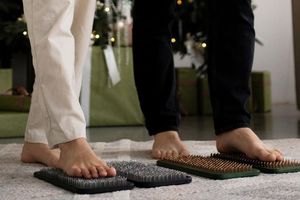

Does Standing on a Sadhu Board Hurt? The Truth No One Talks About
This is probably one of the most common questions people ask before their first practice: does it hurt to stand on a Sadhu board? And the honest answer is: yes, during the first seconds or minutes the sensations can be intense. But the truth is that pain on a Sadhu board is not as straightforward as many people imagine. For most people, the hardest part is not the board itself, but the inner fear of it.
'/><circle cx='1040' cy='60' r='160' fill='rgba(255,255,255,0.06)'/><circle cx='140' cy='350' r='200' fill='rgba(255,255,255,0.04)'/><text x='70' y='150' fill='white' font-family='Arial' font-size='52' font-weight='700'>Does standing on a Sadhu board hurt?</text><text x='70' y='220' fill='%23f0d8b0' font-family='Arial' font-size='36' font-weight='700'>The truth no one talks about</text><text x='70' y='288' fill='rgba(255,255,255,0.86)' font-family='Arial' font-size='24'>About pain, fear, adaptation, and first sensations without fluff</text></svg>)
Your website already has material about the effects and sensations of standing on a Sadhu board, and that is absolutely the right direction. People are not just afraid of nails — they are afraid of the unknown: what will I feel, will I be able to handle it, will it be too much?
In this article, we’ll break it down in a simple, human way:
- whether standing on nails really hurts;
- why the first minutes are the hardest;
- why pain often decreases after a few minutes;
- what affects the sensations — spacing, nail type, fear, preparation;
- how to make your first practice much more comfortable.
Does standing on a Sadhu board really hurt?
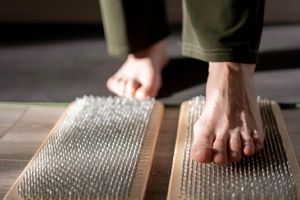
Yes, standing on a Sadhu board can be painful, especially if it’s your first time. But it’s important to understand one thing: this is not the kind of pain a beginner usually imagines. People often think the sensations will be sharp, stabbing, and unbearable. In reality, for many people it feels more like intense pressure, a wave of tension, deep inner focus, and only then — gradual adaptation.
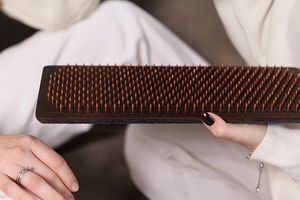
Many people fear the first practice before they even step onto the board. And there is nothing strange about that. On your site, in the article about sensations on the board, it is already described that for beginners the board often looks threatening purely visually because of the large number of sharp nails. That’s true: even before the first step, the mind is already painting the worst-case scenario.
Why the first seconds or minutes are the hardest
For most people, the hardest part is the entry into the practice itself. Not when you’re already standing, but at the moment when you start shifting your body weight onto the nails.
This happens for several reasons:
- the brain perceives the new stimulus as a potential danger;
- the body automatically tenses up;
- the person holds their breath instead of breathing the tension out;
- an inner resistance appears: “I don’t want to,” “I can’t handle this,” “this is too much.”
That is exactly why the first minutes often feel the sharpest. But when a person does not run away from that moment and instead moves through it calmly, the sensations begin to change.

Why the pain often decreases after a few minutes
One of the most interesting things about this practice is that for many people, the sensations begin to change after just a few minutes. Not because the board has changed, but because the body and mind have changed their response.
On your site, in the material about how to stand on a Sadhu board correctly and in the article about solo practice, there is a very good approach: don’t rush, first align yourself, take a few deep breaths in and out, and only then enter the practice gradually. This matters because breathing and relaxation directly affect the sensations.
When a person:
- stops fighting the sensations;
- starts breathing more evenly;
- slightly relaxes the feet, knees, pelvis, and shoulders;
- allows themselves to simply stay in the moment,
— then the tension gradually starts to fade, and with it the feeling of pain often decreases too.
What affects how painful it will feel
The sensations on a Sadhu board do not depend only on your pain threshold. There are several very specific factors that genuinely affect the practice.
1. Nail spacing
This is the most important parameter. That is exactly why the METADESK website already has a separate article about choosing a Sadhu board for beginners, where it is correctly stated: if you have never stood on a board before, it is best to look at 8 mm or 10 mm. It also notes that 10 mm suits most people, while 8 mm can be considered if your pain threshold is low.
To put it simply:
- 8 mm — a softer start;
- 10 mm — the universal option;
- 12–15 mm — a stronger challenge.
2. Nail type
If a person is very afraid of pain or wants a more comfortable entry, it is worth paying attention to Sadhu boards with floating nails. They create different sensations because the nails adjust to the shape of the foot, and for many people that feels more comfortable both physically and psychologically.
3. Fear
Sometimes two people stand on the same board but feel it in completely different ways. Why? Because one enters the practice with tension and fear, while the other enters it with trust in the process. Fear literally intensifies the sensations.
4. The way you step onto the board the first time
If a person shifts their weight onto the board abruptly, tightens the body, and stops breathing — it will be harder. But if they step on slowly, with support, with breath, and without rushing — the sensations are often noticeably softer.
Is it normal to feel very scared before the first time?
Yes, absolutely. For most people, fear of nails is part of their first contact with the practice. And that is exactly why it is so important not just to buy a board, but to choose the right one for your starting point.
If a person doubts whether they will be able to step on at all, they can:
- choose a board with 8 mm or 10 mm spacing;
- stand on it for the first time wearing socks;
- treat the practice not as a timed task, but as a first contact with the sensation;
- stand with support from a wall or another person;
- not expect themselves to do “10 minutes right away.”
By the way, your article about the effects and sensations of a Sadhu board includes a good suggestion: if a person is planning to step on the board for the first time, they can try doing it in socks — for some people this really works as psychological protection and slightly reduces the intensity of the first entry.
What people feel after the first few minutes on the board
This is highly individual, but there are several common states people describe most often:
- relief after “the scariest part is already over”;
- warmth in the legs and body;
- a surge of energy;
- inner silence or focus;
- emotional release.
Sometimes people even cry, laugh, or sit in silence after practice not because it was “too painful,” but because the board quickly brings to the surface what is usually hidden beneath tension, hurry, and noise.
When pain is a signal to stop
It is important to distinguish between intense but manageable sensations and a situation where the practice should be stopped. If a person feels a sudden worsening of their condition, loses orientation, experiences severe dizziness, or has other unusual reactions — it is better to step off the board and not push themselves.
Your website also already has materials about benefits and contraindications. In the articles Sadhu board: benefits for the body and what nail therapy is and what benefits it offers, certain conditions are mentioned where practice should be approached with extra caution or postponed. That is the right approach: a Sadhu board is a powerful tool, but it should be used consciously.
How to make your first practice less painful
If you want your first experience to encourage you rather than push you away, stick to a few simple things:
- choose the right nail spacing — usually 8 mm or 10 mm for beginners;
- don’t rush and don’t “jump” onto the board;
- take a few deep breaths before stepping on;
- don’t force yourself to stand for a long time — the first attempt can be very short;
- don’t judge yourself by a stopwatch — judge by your contact with your body;
- if you are scared, start in socks or with support.
'/><text x='70' y='120' fill='%23ffffff' font-family='Arial' font-size='48' font-weight='700'>The biggest enemy is not the board</text><text x='70' y='185' fill='%23f2d9ad' font-family='Arial' font-size='30'>but tension, fear, and rushing</text><text x='70' y='245' fill='rgba(255,255,255,0.88)' font-family='Arial' font-size='24'>The right entry, breathing, and calmness</text><text x='70' y='285' fill='rgba(255,255,255,0.88)' font-family='Arial' font-size='24'>change the sensations more than it may seem</text></svg>)
The truth no one talks about
Many people look for an answer to the question “does standing on a Sadhu board hurt?” as if there are only two options: either it hurts or it doesn’t. But the real truth is different.
- Yes, it can hurt — especially at the beginning.
- Yes, in most cases the pain changes after a few minutes.
- Yes, fear often scares people more than the board itself.
- Yes, choosing the right nail spacing makes a huge difference.
- And yes — after their first practice, many people say: “I thought it would be much worse.”
Conclusion
So, does standing on a Sadhu board hurt? Yes, the first moments can be intense. But that pain depends greatly on how you enter the practice, which board you choose, how tense your body is, and whether you allow yourself space to adapt.
The best things you can do before your first time are:
- choose the right board;
- not expect records from yourself;
- understand that fear is normal;
- give yourself a chance to get to know the practice gradually.
And then the Sadhu board will not be a “board of pain,” but a tool that opens up a new level of connection with yourself.
Not sure which Sadhu board to choose so you can start without unnecessary fear?
Message us — and we’ll help you choose the right nail spacing, nail type, and board base for your needs. That way, you’ll choose your Sadhu board not at random, but according to your level, your goals, and your first experience.
Frequently asked questions
Does it hurt to stand on a Sadhu board for the first time?
Yes, for most people the first contact with the board feels intense. But usually the hardest part is the first seconds or minutes, after which the sensations begin to change.
Why does the pain on a Sadhu board decrease after a few minutes?
Because the body gradually adapts, and the person starts breathing more calmly and fighting the sensations less. The tension drops — and the practice becomes softer.
What affects pain the most when standing on nails?
The biggest factors are nail spacing, inner fear, the way you enter the practice, and the overall level of tension in the body.
Which Sadhu board is better if you are afraid of pain?
For beginners, people are usually advised to look at 8 mm or 10 mm boards. If the fear is very strong, 8 mm is the softer option to start with.
Can you step onto a Sadhu board in socks the first time?
Yes, for some beginners this works as psychological support and helps them enter their first practice more gently.
When is it better to step off a Sadhu board?
If your condition suddenly worsens, severe dizziness appears, or your body shows an unusual reaction, it is better to stop the practice and not push yourself.
Quick table: what determines how painful it feels to stand on a Sadhu board
If you want a short and clear overview of what affects the sensations, here is a simple table to help you quickly understand the basics.
| Factor | What happens | How it affects the sensations | Recommendation |
|---|---|---|---|
| Nail spacing | The greater the distance, the more intense the sensations | 8 mm is softer, 10 mm is universal, 12–15 mm feels much stronger | For beginners, look at 8 mm or 10 mm |
| Nail type | Static and floating nails create different sensations | Floating nails feel more comfortable for many people | If you feel scared, consider floating nails |
| Fear and tension | The person tightens the body and holds the breath | The sensations become harsher | Don’t rush and breathe slowly |
| First step onto the board | Abrupt or gentle weight transfer | A sudden entry usually feels more painful | Step on slowly and with support |
| Experience | The body and mind get used to the practice | Over time, contact with the board becomes easier | Don’t judge the whole practice by the first attempt |
Want to see Sadhu boards for a comfortable start right away?
Go to the METADESK catalog and explore beginner-friendly options, 8 mm boards, floating nail models, and other solutions that help make the first steps into practice gentler.